-
Home
-
Telescopes
-
Mounted Telescopes
-
Telescope Accessories
-
Binoculars
-
Mounts & Tripods
-
Accessories
-
Guides


£499.00
| /
TS 6" f/9 RC astrograph and travelling telescope - compact Ritchey-Chrétien telescope with 154 mm aperture and 1370 mm focal length - very well suitable for astrophotography.
♦ Aperture 6" / 154 mm
♦ Focal Length 1370 mm
♦ Focal Ratio f/9
♦ Hyperbolic primary and secondary mirror for very high sharpness on the optical axis and a large well-corrected field for astrophotography
♦ Mirrors made of fused silica for stable focus position
♦ 99% dielectric high-reflectivy coating on main and secondary mirror for an even brighter image
♦ Quicker cooling down thanks to open construction
♦ Vixen style dovetail bar for easy attaching to suitable mounts
♦ 2" Crayford focuser with 1.25" reduction adapter and circular clamping
♦ Spacer sleeves for optimal focus position behind the focuser are included.
♦ RC correctors for larger sensors from APS-C upwards are optionally available
♦ Optional: CCD47 - 0.67x focal length reduction for photography our recommendation for shorter exposure times
Most large professional telescope are constructed according to the RC principle. Until recently, these telescopes were unaffordable for amateurs. RC telescopes from are primarily aimed to amateur astronomers with photographic interest.
These telescopes are perfectly suited for high-resolution astrophotography. Of course, an RC can also be used for visual observing. Here, the large corrected field of view is noticeable, too. In total, the stars are sharper than, for example, in a Schmidt-Cassegrain.
♦ Hyperbolic primary and secondary mirror for a large fully illuminated field of view.
♦ Astrophotography with camera sensors up to 30 mm diameter possible without corrector. For larger sensors, like full-frame size, Teleskop-Service offers ready-to-use corrector solutions.
♦ 99% dielectric high-reflectivity coating on main and secondary mirror for an even brighter image.
♦ Significantly shorter cooling down time through open construction and active primary mirror ventilation.
♦ Internal baffles in the tube for even more contrast.
♦ High back focus for correctors, reducers and also binoviewers.
♦ High-quality 2" Crayford focuser for 2" and 1.25" accessories with compression ring
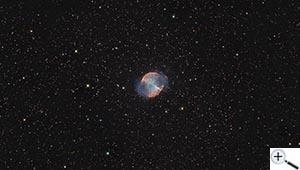
Better and sharper astrophotos without corrector with shorter exposure times. This is exactly what this RC telescope allows you to do with astro cameras and SLRs up to APS-C sensors. As a pure mirror system, you can even use the infrared light. You can achieve up to 25% shorter exposure times and sharper imaging than, for example, through a comparable Schmidt-Cassegrain telescope. For the use of a reflex camera without focal length reduction you need the 50mm and the 25mm extension between focuser and telescope.
The generous backfocus also allows the connection of correctors, which we recommend from the use of full-frame sensors. You can also connect a focal length reducer, thus further increasing the light intensity of the RC.
Quartz glass does not change its dimensions if temperature changes. When the temperature changes slowly during an exposure, other mirror substrates, like Pyrex, tend to a deformation of the mirror and thus to a shift of the focus. This problem does not exist for mirrors of quartz glass. Thus the focus is better maintained which is very important for long exposures. Both mirrors are coated with 99% reflectivity. The image is obviously brighter than the one of telescopes with only 90% or 94% reflection layer.
The TS RC astrographs are true Ritchey-Chrétien telescopes. Maksutovs and Schmidt-Cassegrains have spherical mirrors and need correctors for making a large field usable. With Schmidt-Cassegrains, you can see the aberrations in the field even when working visually. Most times, Maksutov-Cassegrains are so slow that they are not suitable for astrophotography. RC telescopes have hyperbolical primary and secondary mirrors. They are more difficult to manufacture, but offer a significantly sharper field with less aberrations throughout the field.
Celestron EHD or Meade ACF telescopes need a corrector. Additionally, these telescopes have a Schmidt plate at the front side which is prone to dew. The RC is a pure reflection system without lenses in the light path. Thus you can use the complete light even in the infrared range. The image is brighter and the exposure times get shorter. The field of an RC telescope is coma-free by design and relatively flat.
Telescopes with focusing via movable primary mirror often suffer from the "shifting problem". The image shifts while focusing or even jumps. By now, Meade and Celestron have the problem under control, but the effect is noticable nonetheless. TS RC telescopes do not have this problem, as their primary mirror is fixed. Focusing is done via a high-quality focuser. An additional advantage is the optimal distance from primary to secondary mirror. This gives you the guarantee of the best possible image. If the primary mirror moves relatively to the secondary, you will practically never have the optimal distance.


